

 English
 Français
 Español
 Português
 简体中文
 11/06/2026
Beijing Watchdata Co., Ltd. (“Watchdata”) participated in LITE4 (Live Interoperability Test Event 4), an IoT eSIM interoperability test event organized by the GSMA in La Ciotat, France. The five-day intensive laboratory brought together multiple mobile network operators (MNOs), eUICC manufacturers (EUMs), and eSIM IoT Remote Manager (eIM) vendors to conduct cross-implementation interoperability validation against the GSMA SGP.32 specification, with approximately 2,000 test cases scheduled. As an Asia-based solution provider with deep involvement in the event, Watchdata joined global operators and eSIM ecosystem partners in the same laboratory environment to examine whether independently developed SGP.32 products from different vendors can work together in a real industry setting.
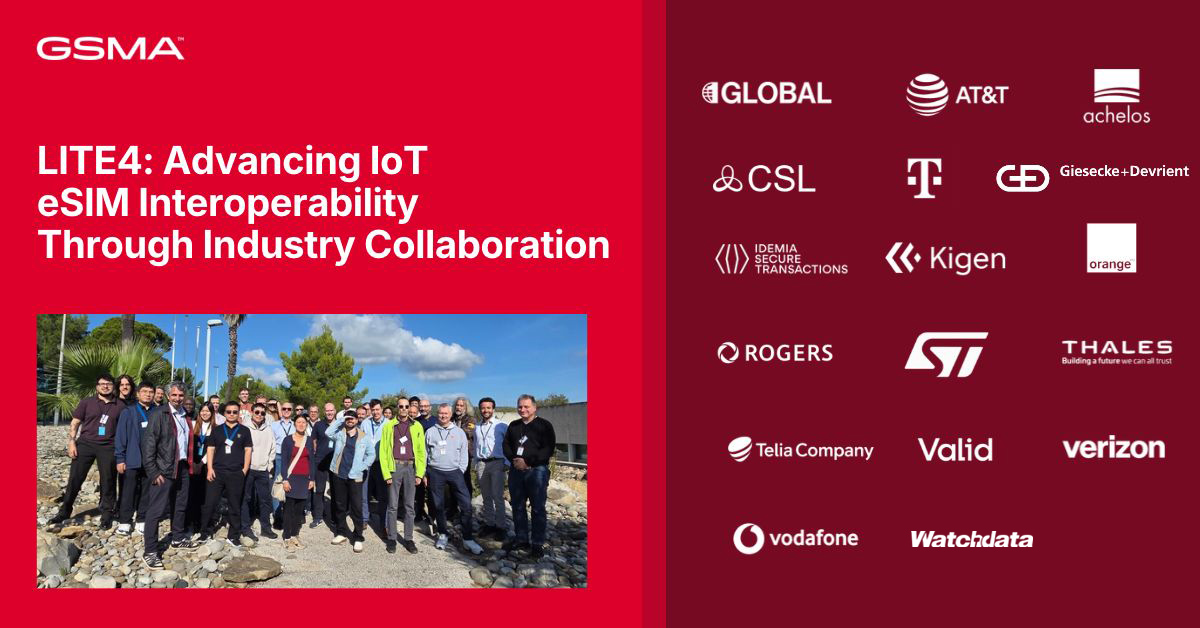
Image source: GSMA Internet of Things LinkedIn
For IoT and connected-vehicle scenarios, Watchdata provides a one-stop capability set aligned with GSMA SGP.32:
covering consumer-, industrial-, and automotive-grade product lines for smartphones and wearables, industrial terminals, and in-vehicle devices;
SGP.32-based remote provisioning and connectivity management, supporting connection-status monitoring, policy management, and API access, while reusing operator-side SM-DP+ to reduce redundant build-out;
including IPA/LPA plugins, test SM-DP+, and test profiles to help customers stand up PoCs quickly;
Watchdata’s relevant capabilities have obtained GSMA SAS-UP and related certifications, and its eSIM SM-DP+/eIM cloud sites are certified under GSMA SAS-SM, providing security assurance for platform operations and scaled delivery.
Building on these capabilities, Watchdata’s solution supports remote operator profile switching, multi-profile management, and resilience mechanisms designed for complex IoT scenarios—including Rollback, Fallback, and Emergency—helping customers balance cross-border deployment, fleet lifecycle connectivity management, and cost efficiency.
SGP.32 is the GSMA eSIM remote provisioning specification for IoT scenarios. Through an eIM working with a device- or card-side IPA (IoT Profile Assistant), it enables remote profile download, enablement, switching, and lifecycle management for headless, low-interaction, and resource-constrained IoT endpoints, while reusing widely deployed SM-DP+ infrastructure. Compared with traditional M2M (SGP.02) approaches, SGP.32 places greater emphasis on orchestration over modern IP protocols and on decoupling hardware choice from connectivity subscription—enabling automakers, module vendors, and IoT platforms to scale deployments without locking into a single connectivity partner. Industry consensus holds that security accreditation, specification conformance, and interoperability answer different questions: the first two show that a product is built to specification and meets security requirements, while interoperability testing shows whether implementations from different suppliers can truly interconnect. Events such as LITE4 place independently developed SGP.32 implementations in the same laboratory environment for validation, giving OEMs a verifiable evidence base for multi-vendor strategies.
In the official LITE4 participant lineup published by the GSMA, Watchdata appears alongside leading global operators and eSIM solution providers including AT&T, Deutsche Telekom, Orange, Verizon, and Vodafone. With testable, integration-ready product implementations, Watchdata entered the GSMA-organized cross-vendor interoperability laboratory and immersed itself in the latest international standards implementation process.
In this laboratory environment, Watchdata validated side by side with leading operators and solution providers—examining interface consistency and implementation differences, and early-testing common interoperability obstacles such as certificate exposure issues, protocol options, and download paths (for example, direct/indirect)—thereby verifying open-ecosystem readiness. At the same time, it provides customers in automotive, metering, asset tracking, and related sectors with an evidence chain of “interoperable, switchable, and scalable,” reducing concerns about single-vendor lock-in and supporting customer sourcing decisions. As an Asia-based solution provider with deep participation, Watchdata works with the GSMA and industry partners to advance SGP.32 from specification text to product robustness, accelerating trusted adoption of IoT eSIM across Asia-Pacific and global markets.
For customers, this means Watchdata’s SGP.32 solution has entered an interoperability context aligned with mainstream international implementations, offering automakers, module vendors, and IoT platforms a basis for selecting “cross-operator, cross-vendor switchable” connectivity—and strengthening Watchdata’s trust credentials when promoting in the Asia-Pacific market: choosing Watchdata means choosing a connectivity path already validated on the same stage as the global leading ecosystem.
“Security accreditation shows that we build to specification; interoperability testing shows whether different implementations can truly work together. LITE4 puts operators, EUMs, and eIMs in the same environment to validate SGP.32—critical for customers evaluating multi-vendor strategies and reducing connectivity lock-in risk. Watchdata will continue to bring its integrated card, platform, and validation-tool capabilities, working with ecosystem partners to turn the specification into product robustness that can scale,” a Watchdata spokesperson said.
Watchdata will continue investing in SGP.32 product and platform capabilities, deepening interoperability cooperation with operators, module makers, and device manufacturers, and—backed by GSMA-certified security architecture and open interfaces—helping customers achieve IoT deployment goals of “integrate once, connect globally, and operate across the full lifecycle.”